FOR IMMEDIATE RELEASE
Media Contacts:
Mo Schriner
Minnesota Department of Commerce
Email: [email protected]
Shaylyn Bernhardt
Clean Energy Resource Teams
Phone: 612.720.4025
Email: [email protected]
Jessica Sund
Director of Development and Communications – Channel One Regional Food Bank
Phone: 507.269.2885
Email: [email protected]
SAINT PAUL, Minn. (January 19, 2022) —
Minnesota’s Clean Energy Resource Teams (CERTs) awarded seed grants to 74 innovative energy efficiency and renewable energy projects – over twice as many as last round – in communities from Warren to Winona, Morton to Mountain Iron, Long Prairie to Lindstrom. The communities are funded for a wide range of energy projects, from improving buildings for energy efficiency to job skills training for careers in clean energy.
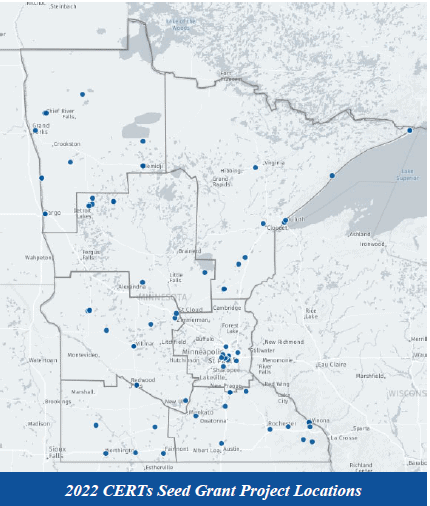
This year, seed grants with a focus on underserved communities received additional funding. Underserved communities encompass a range of populations, such as BIPOC communities and households with high energy burdens, where they spend more than 5% of their annual income on energy costs, compared to 2% for the average Minnesota household.1 For example, the Akiing 8th Fire project engages both White Earth Tribal members and people from the Lower Sioux Nation in a solar thermal installation and collaborative training effort. Numerous projects throughout Minnesota focus on energy efficiency in manufactured housing.
The doubling of seed projects and expansion of grants for underserved communities are the result of a successful public-private partnership. The Minnesota Department of Commerce Conservation Improvement Program allocation for seed grants was renewed by the Legislature at $140,000. Commerce added $120,000 more for projects focused on underserved communities by leveraging its State Energy Office funds from the U.S. Department of Energy. In addition, a new award from the Morgan Family Foundation provided an additional $70,000 in CERTs Seed Grant funding.
“These seed grants will advance community initiatives, support local opportunities for jobs and training, and engage communities in reaching their clean energy goals,” says Lissa Pawlisch, CERTs statewide director.
Commerce Commissioner Grace Arnold said, “Through these local projects, Minnesotans across the state are investing in the future. These projects will save money, save energy, grow jobs and build more resilient communities.”
Seed grants encourage community-driven projects that help people see clean energy working in their own communities and provide communities with opportunities to tangibly learn about and experience the benefits of clean energy. The 74 funded projects span a broad range of energy efficiency and renewable energy technologies along with electric vehicle charging. Many projects also include components of education, outreach and community building.
These awards mark the 11th round of CERTs Seed Grants, totaling over $1.6 million to 467 projects since 2006. The complete list of funded projects with descriptions and grant amounts is available at https://cleanenergyresourceteams.org/2022grants
1 CERTs defines underserved populations as energy burdened communities — those who spend more than 5% of their income on energy costs — and other groups historically excluded from energy decisions and opportunities. This includes (but is not limited to) Black, Indigenous and People of Color, immigrants, low income, disabled, women, LGBTQ+ communities, and geographically isolated communities.
(A description of Channel One’s funded project as well as the grant amount follows. It is not included in the pdf version of the press release, but is available at here)
ROCHESTER, MN —
Channel One Regional Food Bank (C1) partnered with RETAP to evaluate their energy management practices and potential energy efficiency projects. Retrofitting C1’s lighting load was recognized as the best place to realize efficiencies and this project will implement the recommendations. By investing in energy efficiency upgrades, C1 will reserve general operating funds for their mission to end hunger in their region and demonstrate the viability of energy efficiency upgrades to other nonprofits, especially their network of 200 partnering food shelves and local food security programs. ($3,550 Commerce)